
 Contact Us
 Home / /


Custom Nylon Screw in PA66 with M8 Threaded Design
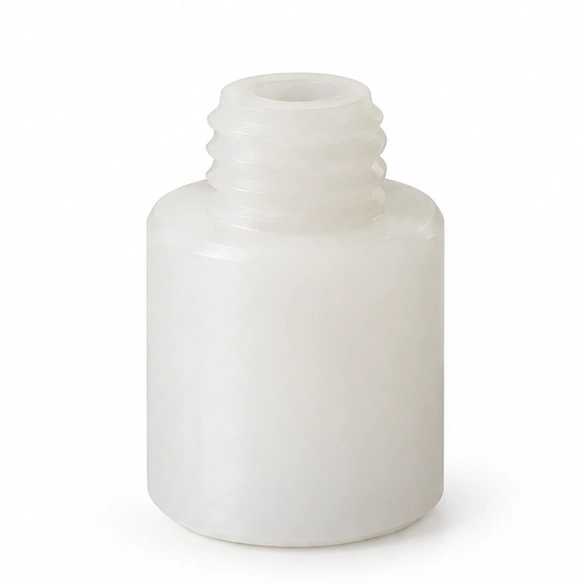
Custom Nylon Screw is a special purpose engineering plastic nylon PA66 screw with enlarged body, short external thread length and recessed circular hole on opposite end face. The part is called “Vite Speciale M8” by the customer using the drawing, a specifically developed M8 screw.
The selection of PA66 nylon parts for use as fasteners is flexible, with each part being able to conform and absorb moisture in accordance with the state of the material. Different considerations are involved in the machining of PA66 nylon products than are associated with standard metal fasteners because PA66 nylon parts are very flexible and sensitive to the cutting force applied. The project is based on the manufacturing processes needed to manufacture a small custom plastic component with controlled surface quality and geometry that can be provided as a plastic original equipment manufacturer (OEM).
-
Product Name: Custom Nylon Screw
-
Drawing Description: Vite Speciale M8 (Special M8 Screw)
-
Material: PA66 / Nylon 66
-
Thread Specification: M8 (Per Drawing)
-
Suggested Manufacturing Process: Precision CNC Turning and Threading
-
Main Features: Enlarged Body, Short External Thread and Recessed End Opening
-
Unspecified Chamfers: 0.5 × 45°
-
Surface Roughness: According to Drawing Surface Symbols
-
Surface Treatment: Not Specified
-
Manufacturing Type: Custom Drawing-Based Plastic Component
 Get Free Quote


Precision Machining Requirements for PA66 Nylon Screws
The component combines a relatively large body with a smaller threaded projection.
This geometry introduces different machining challenges from those encountered when producing conventional steel or brass screws.
PA66 is less rigid than most metals, and excessive clamping pressure or cutting forces can affect the finished profile.
For similar parts, CNC turning provides a practical method for producing rotational features, while suitable threading operations can form the external screw section.
Controlling the M8 External Thread
The M8 threaded projection is one of the main features of this custom component.
Unlike metal threads, machined nylon threads require attention to material deformation and burr formation.
Important manufacturing considerations include:
- Maintaining the specified external thread profile
- Controlling cutting forces during threading
- Preventing thread deformation
- Producing clean thread entrances and exits
- Checking compatibility with the mating component
The engineering drawing identifies the M8 designation, but the complete thread pitch and tolerance requirements should be confirmed from the detailed drawing.
Karry Precision's CNC turning services support custom rotational parts manufactured from engineering materials.
Machining the Enlarged Screw Body
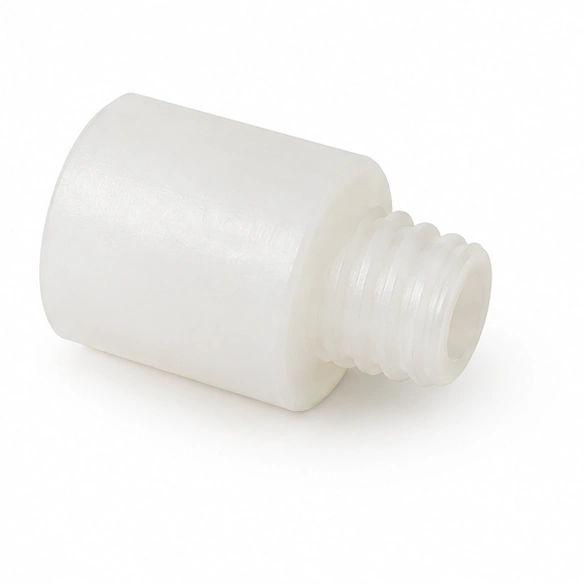
The photographs show an enlarged white nylon body connected to the smaller threaded section.
Maintaining the relationship between these features is important for achieving the intended component geometry.
For comparable machined plastic components, stable workholding should provide adequate support without applying excessive clamping force.
Suitable cutting tools and carefully controlled finishing passes can help reduce surface damage and dimensional variation.
Machining the Recessed End Feature
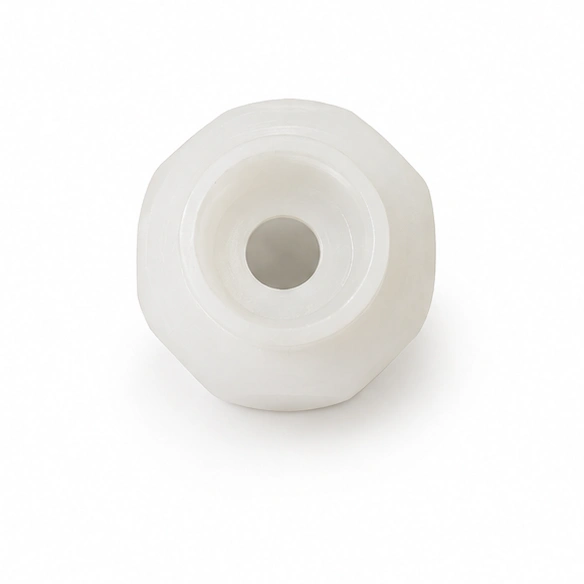
The opposite end of the component contains a circular recessed feature with a smaller central opening visible in the photograph.
Producing this geometry may require drilling, boring, or another appropriate internal machining operation, depending on the approved drawing.
The internal feature should be inspected for burrs, surface defects, and dimensional conformity.
The available images do not establish whether the central opening passes completely through the component.
Why PA66 Nylon for Custom Screws?
PA66, also known as Nylon 66, is an engineering thermoplastic commonly used for mechanical and electrical components.
Its material characteristics can make it suitable for specialized screws, spacers, bushings, and other custom plastic parts.
Electrical Insulation: PA66 is generally electrically insulating, making it useful where a nonconductive material is required.
Low Weight: Nylon is significantly lighter than many common engineering metals.
Mechanical Strength: PA66 provides useful strength and toughness when selected for suitable operating conditions.
Machining Compatibility: Nylon stock can be machined into custom cylindrical profiles, threads, and internal features.
Corrosion Resistance: Unlike ordinary steel, nylon does not undergo metallic rusting.
However, PA66 absorbs moisture, which can affect its dimensions and mechanical properties. Its suitability must be evaluated against the required load, temperature, environment, and long-term fastening conditions.
Technical Specifications
| Parameter | Specification |
|---|---|
| Product Name | Custom Nylon Screw |
| Drawing Description | Vite Speciale M8 |
| Material | PA66 (Nylon 66) |
| Thread Designation | M8 |
| Main Structure | Enlarged Body with Threaded Projection |
| End Feature | Circular Recess with Central Opening |
| Suggested Machining | CNC Turning, Threading and Internal Machining |
| Unspecified Edge Chamfer | 0.5 × 45° |
| Surface Roughness | Per Applicable Drawing Symbols |
| Surface Treatment | Not Specified |
| Drawing Revision | Rev. 0 |
| Production Basis | Customer Engineering Drawing |
The supplied drawing excerpt does not provide complete dimensional views, overall lengths, thread pitch, or individual tolerance values.
Dimensional Stability and Surface Quality
Machining PA66 requires a different approach from machining brass, stainless steel, or aluminum.
One important consideration is dimensional stability.
Nylon can deform under excessive clamping pressure, and its dimensions may change with moisture content.
For precision parts, machining conditions, storage environment, and inspection timing should therefore be considered when establishing dimensional acceptance requirements.
Surface Finish and Chamfer Requirements
The drawing includes surface roughness symbols showing values such as Ra 0.2, Ra 0.8, Ra 3.2, and Ra 12.5 μm.
These are drawing references rather than evidence that every surface must achieve the same roughness.
The applicable roughness value for each feature must be confirmed from the complete technical drawing.
The drawing also identifies an unspecified chamfer requirement of 0.5 × 45°.
Suitable edge finishing can help remove sharp edges and machining burrs while maintaining the required part geometry.
Quality Control for Custom Plastic Screws
Inspection of a machined nylon screw should focus on both dimensional conformity and the condition of its threaded features.
| Inspection Feature | Quality Control Focus |
|---|---|
| External M8 Thread | Thread profile, size and mating fit |
| Main Body | External dimensions and shape |
| Threaded Projection | Length and alignment |
| Recessed End Feature | Opening dimensions and edge quality |
| Chamfered Edges | 0.5 × 45° where applicable |
| Surface Condition | Burrs, tool marks and specified roughness |
| Dimensional Stability | Measurement conditions and moisture-related variation |
Appropriate inspection methods may include calipers, optical measurement equipment, thread gauges, and other tools selected according to the engineering drawing.
Because PA66 is more compliant than metal, inspection methods should avoid applying excessive measuring force.
See Karry Precision's tolerance and quality control capabilities for further information.
Manufacturing Considerations for Custom PA66 Fasteners
The photographed parts show a compact design with a short threaded projection and an enlarged body.
For comparable custom plastic fasteners, production planning should consider the selected nylon grade, part geometry, thread requirements, and expected assembly conditions.
Machining can be useful for prototype development and customized designs where tooling investment needs to be evaluated.
For larger quantities, the relative cost of CNC machining and injection molding may also be considered, depending on the geometry, tooling cost, and required tolerances.
The available drawing does not specify production volume, so the most economical manufacturing method should be determined during quotation.
Potential Applications of PA66 Nylon Screws
The drawing does not confirm the final equipment application.
Depending on their design and mechanical requirements, similar nylon screws may be considered for:
- Electrical insulation assemblies
- Industrial equipment
- Lightweight mechanical components
- Custom plastic fastening systems
- Equipment requiring nonmetallic hardware
PA66 material compatibility, threaded load capacity, and operating temperature must be evaluated for each application.
Frequently Asked Questions
What is a custom nylon screw?
A custom nylon screw is a fastener made from nylon material according to specific design requirements. It may include nonstandard head geometry, threads, shoulders, or other machined features.
What does PA66 mean in nylon screw manufacturing?
PA66 stands for Polyamide 66, an engineering thermoplastic used for mechanical and electrical components. It offers useful strength, toughness, and electrical insulating properties.
Can PA66 nylon be CNC machined?
Yes. PA66 can be machined using suitable CNC processes, including turning, drilling, and threading. Cutting conditions and workholding should account for the material's flexibility and thermal behavior.
Can CNC turning produce M8 nylon threads?
Yes. External M8 threads can be machined in suitable PA66 stock using appropriate tools and process parameters. Final thread dimensions and fit should follow the approved drawing.
Does PA66 absorb moisture?
Yes. PA66 is hygroscopic and absorbs moisture from its surroundings. Moisture absorption can affect dimensions and mechanical properties, which should be considered when specifying tight tolerances.
Can Karry Precision manufacture custom nylon screws?
Karry Precision offers custom CNC machining services for engineering materials. Customers can submit technical drawings or CAD models to review material selection, threaded geometry, machining feasibility, and inspection requirements.