
 Contact Us
 Home / /
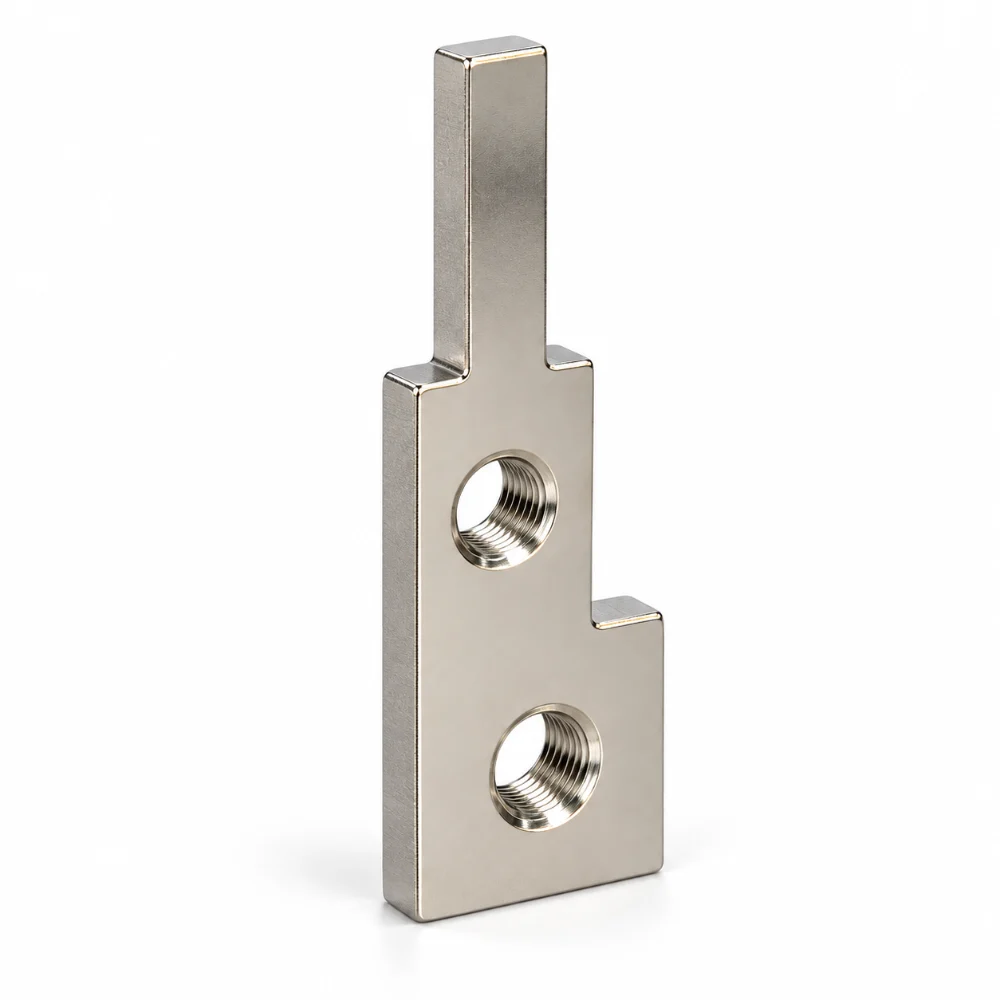
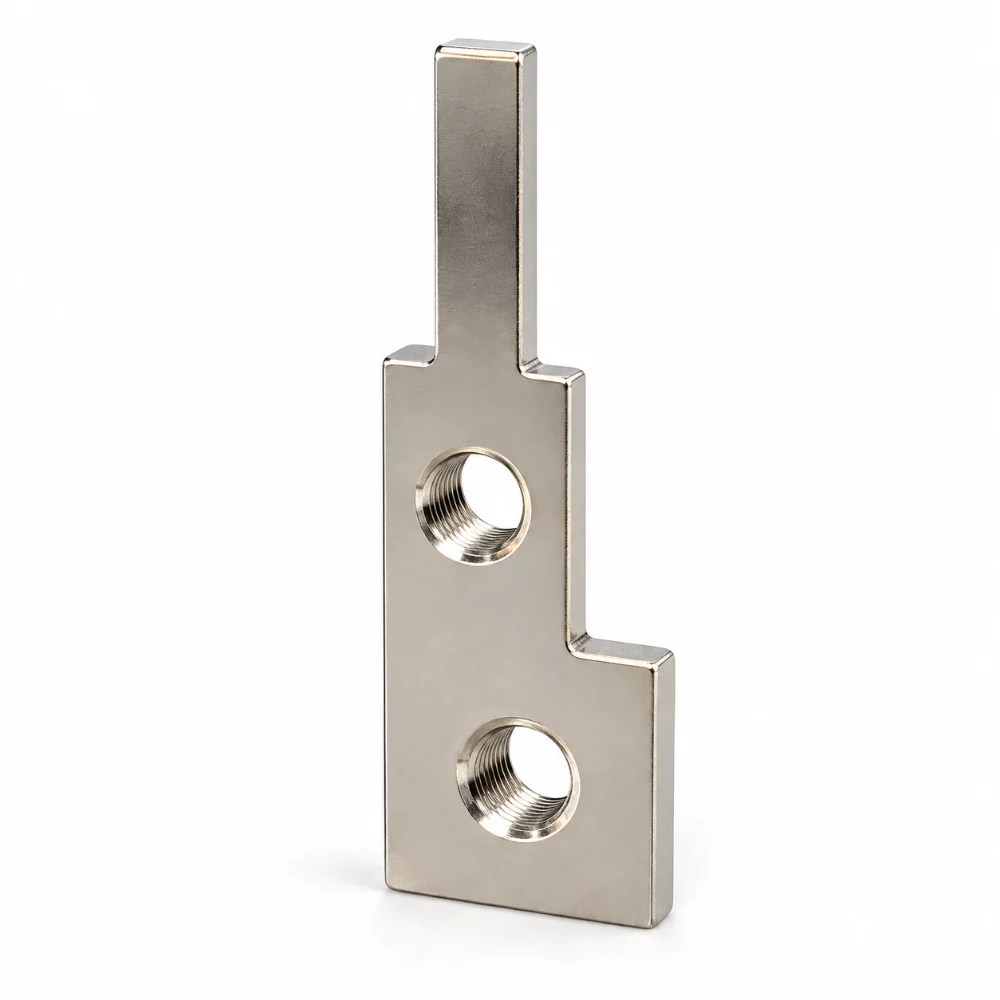


Custom Electrical Terminals with Silver Plated C954 Bronze
These Custom Electrical Terminals are precision-machined from C954 aluminum bronze for a specialized electrical tester assembly. Each terminal features a stepped metal body, two threaded mounting holes, a narrow extension, and a silver-plated surface.
The component measures approximately 38.10 × 11.08 × 6.35 mm and incorporates two 10-32 UNF threaded holes. Manufacturing requirements include precision CNC milling, drilling, tapping, and silver plating. The specified general tolerance is ±0.005″ (±0.13 mm), with a surface roughness requirement of Ra 3.2 μm.
-
Product Name: Custom Electrical Terminal
-
Material: C954 Aluminum Bronze
-
Manufacturing Process: Precision CNC Milling, Drilling and Tapping
-
Dimensions: 38.10 × 11.08 × 6.35 mm
-
Thread Specification: 10-32 UNF, 2 Places
-
Dimensional Tolerance: ±0.005″ (±0.13 mm)
-
Surface Roughness: Ra 3.2 μm
-
Surface Treatment: Silver Plating, 20–30 μm Specification
-
Main Features: Stepped Body, Dual Threaded Holes and Narrow Extension
-
Application: Electrical Tester Assembly
-
Production Type: Custom CNC Machined Electrical Components
 Get Free Quote


More Than a Conventional Metal Terminal
A typical electrical terminal may consist of a flat metal strip with a simple fastening hole. This project uses a more specialized shape.
Its stepped body provides two different mounting levels, while a narrow extension projects from one end. Two threaded holes are positioned along the larger machined sections.
This geometry introduces several manufacturing considerations.
The extension needs to retain its intended shape without excessive material removal. The threaded holes must remain correctly positioned relative to the steps, and the transition between sections requires careful edge finishing.
These details become particularly important when the part must fit an existing tester assembly.
Rather than treating the component as a standard electrical lug, the machining process must follow its specific profile and fastening requirements.
Machining C954 Aluminum Bronze for Electrical Components
C954 aluminum bronze is a copper-based alloy selected for applications requiring useful mechanical strength and wear resistance.
For this terminal, the material specification influences cutting conditions, machining strategy, and surface preparation.
Producing the stepped profile involves removing material from different levels while preserving the relative positions of the two threaded holes.
The narrow extension also requires attention during workholding and machining to avoid damaging its edges.
A suitable precision CNC milling process can produce these geometric features from the specified bronze material.
The manufacturing goal is not simply to achieve the correct external shape. The machined surfaces must also be suitable for the subsequent silver-plating process.
Why Silver Plating Matters for This Terminal
The drawing specifies a silver coating with a thickness greater than 20 μm and less than 30 μm.
This is a meaningful requirement because the coating becomes part of the finished component's surface dimensions.
Silver is widely used for electrical contact surfaces due to its high electrical conductivity. However, the electrical performance of a completed terminal also depends on the mating surface, contact pressure, assembly arrangement, and coating quality.
In this project, silver plating must be considered alongside the machining requirements.
The finishing process needs appropriate surface preparation, coating control, and post-plating inspection.
A bright silver appearance alone does not establish compliance with the specified plating thickness or electrical performance requirements.
This is an important distinction when manufacturing electrical terminals for testing or other industrial equipment.
The Threaded Holes Create a Second Manufacturing Challenge
The component has two 10-32 UNF threaded holes, with Ø0.159″ through-hole preparation specified on the drawing.
Their locations are distributed across the stepped profile rather than a single uniform rectangular section.
For a terminal of this size, hole position and thread quality directly affect mechanical installation.
The manufacturing process should address the following:
- Hole positioning: Maintain the specified distances between the holes and surrounding machined features.
- Thread machining: Produce the required 10-32 UNF internal threads with suitable tools.
- Edge finishing: Remove machining burrs around the openings without affecting the intended profile.
- Post-plating fit: Verify that the plated threads remain compatible with the specified fastening hardware.
Because the holes are located in different sections of the terminal, accurate machining references are essential for maintaining the intended dimensional relationship.
Planning Machining and Plating as One Process
For silver-plated precision components, machining and finishing cannot always be considered separately.
The coating introduces an additional dimensional variable that should be reviewed before finalizing the machining plan.
| Manufacturing Stage | Key Consideration |
|---|---|
| Material Preparation | Verify the C954 aluminum bronze specification |
| CNC Milling | Produce the stepped body and narrow extension |
| Drilling and Tapping | Machine the two 10-32 UNF threaded holes |
| Deburring | Control sharp edges and internal corner conditions |
| Surface Preparation | Prepare the bronze surfaces for the specified coating |
| Silver Plating | Meet the 20–30 μm coating thickness specification |
| Final Inspection | Check finished dimensions, threads and surface condition |
In particular, coating buildup around small threaded features must be considered during the process review.
This approach helps connect machining decisions with the actual finished-part requirements rather than treating silver plating as a purely cosmetic operation.
What the Finished Parts Reveal
The production photographs show multiple terminals with matching stepped profiles and two visible fastening holes.
Their metallic surfaces also show the reflective appearance associated with the specified silver finish.
The most recognizable feature is the narrow terminal extension connected to the wider stepped body.
This makes the component visually distinct from ordinary flat electrical terminals or simple machined blocks.
However, visual inspection cannot establish thread acceptance, dimensional tolerances, or coating thickness.
Those requirements must be assessed using the appropriate inspection methods.
Inspection Focus for the Finished Electrical Terminals
The engineering documentation specifies standard inspection reporting and drawing-based dimensional requirements.
For these terminals, an inspection plan should concentrate on the features most likely to affect assembly fit.
| Inspection Item | Drawing Requirement |
|---|---|
| Overall Length | 38.10 mm |
| Maximum Width | Approximately 11.08 mm |
| Thickness | 6.35 mm |
| Internal Threads | 2 × 10-32 UNF |
| General Tolerance | ±0.13 mm |
| Surface Roughness | Ra 3.2 μm |
| Silver Coating | Greater than 20 μm and less than 30 μm |
| External Geometry | Stepped profile and narrow extension |
Dimensional inspection can verify the external profile and hole locations, while suitable thread gauges can evaluate the finished threaded features.
Coating thickness should be verified through an appropriate test method when required by the approved inspection plan.
By separating dimensional, thread, and coating checks, manufacturers can evaluate the different functions of the component more effectively.
Where Similar Custom Electrical Terminals Are Used
Although this component is designed for a tester assembly, comparable machined and plated terminal designs may be specified for other equipment.
Examples include electrical testing fixtures, specialized contact assemblies, industrial instruments, and custom electrical connection hardware.
The exact geometry, material, and coating requirements vary depending on the equipment design.
For purchasing engineers, the key consideration is whether the manufacturer can produce the specified connection features while coordinating the required surface treatment.
That combination is particularly relevant for custom terminals that cannot be replaced by standard off-the-shelf connectors.
Frequently Asked Questions
What materials can be used for custom electrical terminals?
Copper alloys, brass, aluminum bronze, and other metals may be considered depending on mechanical strength, conductivity, corrosion resistance, and manufacturing requirements.
Why is C954 aluminum bronze used in this project?
C954 aluminum bronze provides mechanical strength and wear resistance. Its use in this project is specified together with silver plating and precision-machined connection features.
What is the purpose of silver plating on electrical terminals?
Silver plating provides a conductive surface that can be useful in electrical contact applications. Actual electrical performance depends on the complete contact design and operating conditions.
Can CNC machining produce electrical terminals with 10-32 UNF threads?
Yes. CNC drilling and tapping processes can produce 10-32 UNF threaded features in suitable materials, subject to the component geometry and required inspection criteria.
Does silver plating affect terminal dimensions?
Yes. Silver plating adds material to coated surfaces, which can affect the dimensions and fit of precision features, especially threaded holes and mating surfaces.
What information is needed to manufacture custom electrical terminals?
A complete manufacturing specification should include the part geometry, material grade, thread details, tolerances, coating requirements, quantity, and any relevant functional inspection criteria.