
 Contact Us
 Home /
Custom Manufacturing Process: From RFQ to Finished Parts


Table of Contents
- Step 1: Submit Your Project Requirements
- Step 2: Engineering and DFM Review
- Step 3: Quotation and Manufacturing Planning
- Step 4: Material Selection and Preparation
- Step 5: Prototype or Sample Production
- Step 6: Production and In-Process Control
- Step 7: Surface Finishing and Secondary Operations
- Step 8: Final Inspection and Quality Verification
- Step 9: Packaging and Delivery
- How to Make a Custom Manufacturing Order More Efficient
- From Prototype to Repeat Production
-
Custom Manufacturing Process FAQ
- What information should I send for a custom manufacturing quote?
- Does every custom part require a prototype?
- Which manufacturing process is best for custom parts?
- How can I reduce custom manufacturing costs?
- How is quality controlled during custom manufacturing?
- Can Karry Precision support both prototypes and production orders?

A clear custom manufacturing process helps turn drawings and product requirements into parts that can be quoted, produced, inspected, and delivered consistently. For engineers and purchasing teams, understanding each stage also makes it easier to control cost, lead time, quality, and production risk.
At Karry Precision, custom projects can involve CNC machining, sheet metal fabrication, 3D printing, injection molding, die casting, and supporting manufacturing processes depending on the part design, material, quantity, and application.
Step 1: Submit Your Project Requirements
A manufacturing project usually begins with the customer sharing the available technical information.
For a more accurate review and quotation, it is helpful to provide:
- 2D drawings and 3D CAD models
- Material grade
- Required quantity
- Critical dimensions and tolerances
- Surface finish requirements
- Application or assembly information
- Inspection or documentation requirements
- Expected delivery schedule
STEP, STP, IGES, X_T, DWG, DXF, and other common engineering file formats can help the manufacturing team understand the part geometry and production requirements.
Providing complete information early reduces unnecessary clarification and helps the supplier prepare a more accurate manufacturing plan.
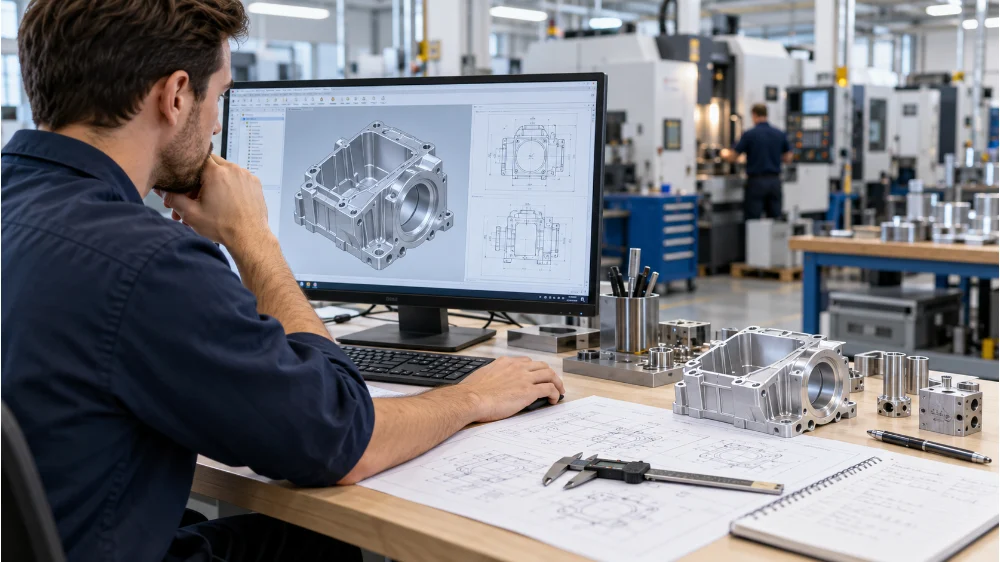
Step 2: Engineering and DFM Review
Before production begins, the drawings and models should be reviewed for manufacturability.
During a DFM review, engineers may evaluate:
- Part geometry and machining access
- Wall thickness and deep cavities
- Hole and thread specifications
- Tight tolerance requirements
- Material machinability
- Surface finish requirements
- Assembly interfaces
- Suitable manufacturing processes
The goal is not simply to change the customer's design. A good review identifies areas that may increase machining time, tooling requirements, setup complexity, or production cost while protecting the functional requirements of the part.
For CNC-based projects, customers can learn more about our CNC machining capabilities.
Step 3: Quotation and Manufacturing Planning
Once the technical requirements are clear, the manufacturer can develop a quotation and production plan.
The cost of a custom part can be affected by several factors, including:
| Factor | Effect on Manufacturing |
|---|---|
| Material | Affects raw material cost and machinability |
| Geometry | Complex features may require additional setups |
| Tolerances | Tighter requirements can increase machining and inspection time |
| Quantity | Influences setup cost and unit pricing |
| Surface Finish | Adds secondary processing steps |
| Inspection | Special reports or inspection requirements may add time |
| Delivery | Production and logistics schedules affect overall lead time |
The lowest unit price is not always the only consideration. Buyers should also review whether the quotation clearly reflects the drawing, material, tolerance, finishing, inspection, and delivery requirements.
Step 4: Material Selection and Preparation
Material selection affects strength, weight, corrosion resistance, appearance, thermal performance, electrical properties, machining efficiency, and overall cost.
Common materials for custom manufacturing include:
- Aluminum alloys
- Stainless steel
- Carbon and alloy steels
- Brass and copper
- POM, nylon, PEEK, and other engineering plastics
The material should be selected according to the actual application rather than price alone.
If the material has not yet been finalized, our materials guide provides additional information about common options for precision manufacturing.
Step 5: Prototype or Sample Production
For new designs, a prototype or engineering sample can help verify the part before repeat production.
Depending on the project, prototypes may be used to evaluate:
- Dimensions and assembly fit
- Functional interfaces
- Material selection
- Surface appearance
- Design changes
- Manufacturability
CNC machining is often suitable for functional metal and plastic prototypes because the same basic manufacturing method can also support later low-volume or repeat production.
Other projects may use 3D printing, sheet metal fabrication, or a combination of processes depending on what needs to be validated.
Step 6: Production and In-Process Control
After the design, quotation, and production requirements are confirmed, the project moves into manufacturing.
The production route depends on the component. A part may require CNC milling, CNC turning, 5-axis machining, drilling, tapping, EDM, sheet metal work, or secondary processing.
During production, important dimensions and process requirements should be checked at appropriate stages rather than waiting until every part is finished.
This helps identify potential variation earlier and supports more consistent repeat production.
Step 7: Surface Finishing and Secondary Operations
Many custom parts require additional processing after the main manufacturing operation.
Common options can include:
- Anodizing
- Bead blasting
- Brushing
- Polishing
- Powder coating
- Plating
- Painting
- Laser marking
- Heat treatment where required
Surface finishing can affect appearance, corrosion resistance, wear performance, electrical characteristics, and final dimensions.
Customers should identify cosmetic surfaces, masking requirements, color expectations, and fit-critical areas before finishing begins.
See our surface finishing options for more information.
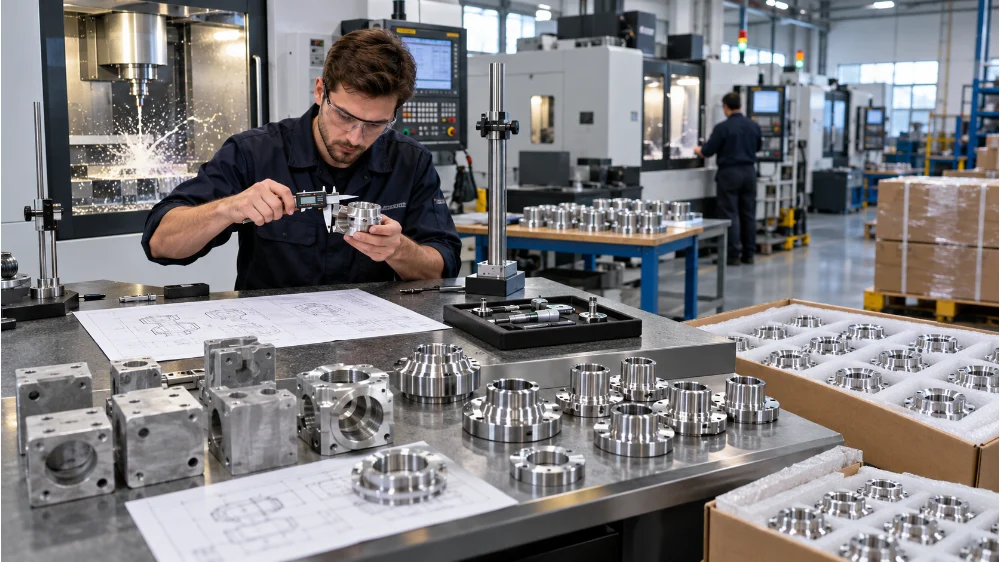
Step 8: Final Inspection and Quality Verification
Before shipment, finished parts should be checked against the agreed requirements.
Inspection may include:
- Overall dimensions
- Hole locations and diameters
- Threads
- Critical tolerances
- Surface appearance
- Finished interfaces
- Quantity and identification
- Customer-specified inspection requirements
Different parts require different inspection methods depending on geometry and tolerance.
For more information, see our Tolerance and Quality Control capabilities.
Step 9: Packaging and Delivery
Once inspection is complete, parts are cleaned and packaged according to their size, finish, material, and transportation requirements.
Sensitive cosmetic surfaces and precision features may require additional protection to reduce damage during shipping.
The appropriate delivery method depends on:
- Shipment size
- Weight
- Destination
- Required delivery date
- Cost considerations
Good packaging and clear part identification are especially important for repeat orders and multi-part projects.
How to Make a Custom Manufacturing Order More Efficient
The manufacturing process usually moves faster when the supplier receives complete and controlled technical information from the beginning.
Before requesting a quotation, try to confirm:
- Final 2D and 3D files
- Material grade
- Quantity
- Critical tolerances
- Surface finish
- Inspection requirements
- Delivery destination
If some details are still under development, identify them clearly so the engineering team knows which requirements are fixed and which can still be optimized.
From Prototype to Repeat Production
A well-managed custom manufacturing process does more than produce the first acceptable sample.
As a project moves toward repeat production, manufacturers and customers should maintain control over drawings, material specifications, finishing requirements, inspection criteria, and engineering revisions.
Keeping these requirements consistent helps reduce confusion between production batches and makes future orders easier to manage.
Custom Manufacturing Process FAQ
What information should I send for a custom manufacturing quote?
Provide your 2D drawings or 3D models together with the material, quantity, tolerances, surface finish, inspection requirements, and delivery information. Complete project information helps the manufacturer review feasibility and prepare a more accurate quotation.
Does every custom part require a prototype?
No. A prototype is particularly useful for new designs, complex assemblies, or parts that require functional verification. Simple or previously validated parts may be able to move directly into production after engineering review.
Which manufacturing process is best for custom parts?
It depends on the material, geometry, tolerance, quantity, and application. CNC machining may be suitable for precision metal or plastic parts, while sheet metal, 3D printing, injection molding, die casting, or combined processes may be more appropriate for other designs.
How can I reduce custom manufacturing costs?
Avoid unnecessarily tight tolerances, confirm the appropriate material, simplify difficult features where possible, and provide clear quantities and finishing requirements. Early DFM review can also identify features that increase machining or setup time.
How is quality controlled during custom manufacturing?
Quality should be checked at several stages, including material verification, in-process inspection, final dimensional verification, surface checks, and pre-shipment inspection. The exact inspection plan depends on the drawing and project requirements.
Can Karry Precision support both prototypes and production orders?
Yes. Karry Precision supports engineering samples, prototypes, low-volume manufacturing, and repeat production for custom precision components based on customer drawings and project requirements.
Talk to the Manufacturer, Not a Middleman
Resources & Insights
-
 Industry Insights
How Custom Manufacturing Orders Work: A Step-by-Step Guide
2026-08-05By Karry Precision -
 Industry Insights
Custom Manufacturing Process: From RFQ to Finished Parts
2026-08-05By Karry Precision -
 Industry Insights
How to Evaluate a CNC Milling Supplier Beyond the Quoted Price
2026-08-05By Karry Precision -
 Industry Insights
From Prototype to Production: How CNC Milling Supports Product Development
2026-08-05By Karry Precision