
 Contact Us
 Home / /
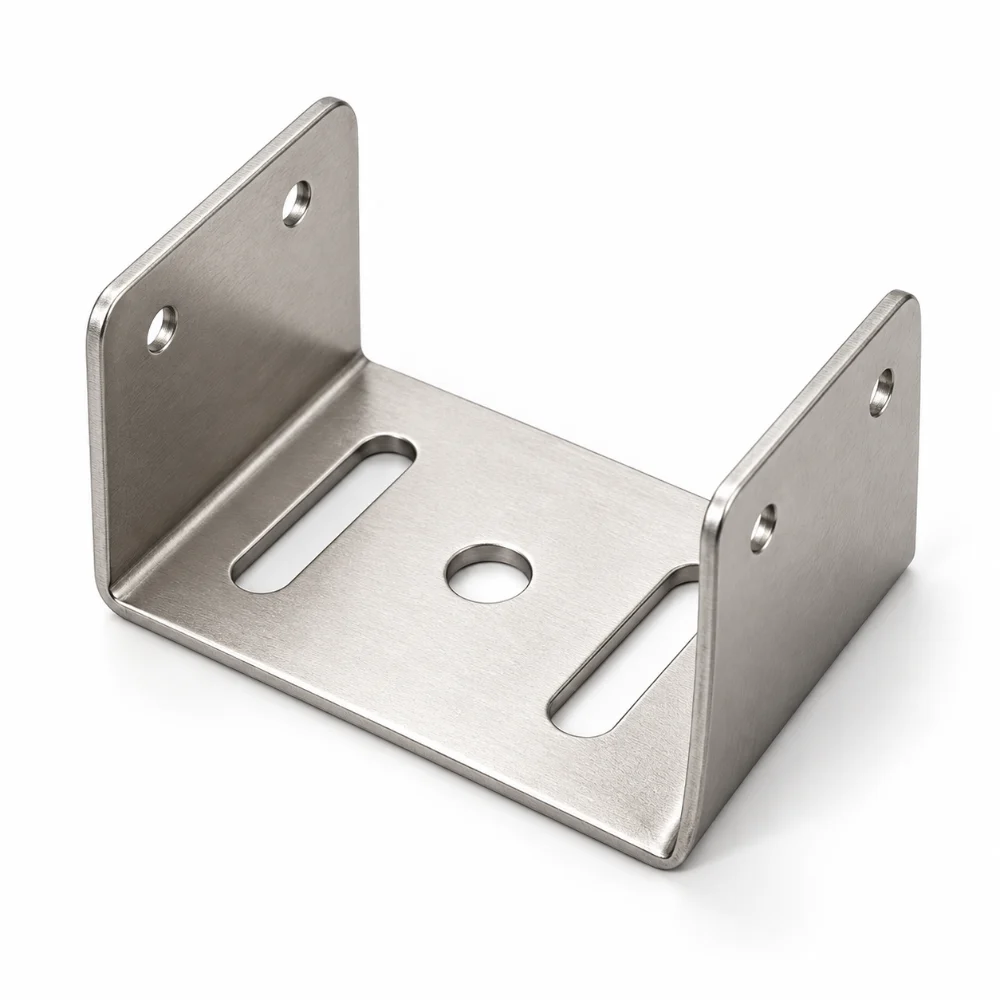


Custom 304 Stainless Steel U Bracket for Equipment Mounting
A 304 Stainless Steel U-Shaped Bracket provides a compact mounting structure for positioning, supporting, or securing components inside industrial equipment. Its channel-shaped body creates two opposing side walls connected by a base, making it useful for assemblies requiring controlled spacing and accessible mounting points.
This fabrication example focuses on U-channel geometry, stainless steel forming, flange alignment, and assembly fit. The main engineering considerations include maintaining consistent internal clearance, reducing bending distortion, and preparing smooth edges for installation.
-
Component: Custom U-Shaped Sheet Metal Bracket
-
Material: 304 Stainless Steel (SUS304)
-
Manufacturing: Laser Cutting and CNC Press-Brake Bending
-
Surface Finish: Natural Stainless Steel, Deburred
-
Structural Features: U-Channel Body, Opposing Flanges and Optional Mounting Cutouts
-
Tolerances: According to Approved Drawings
-
Applications: Equipment Mounting, Enclosures and Mechanical Assemblies
-
Customization: Channel Width, Flange Height, Sheet Thickness and Hole Layout
 Get Free Quote


U-Shaped Bracket Design and Manufacturing
Unlike flat mounting plates, U-shaped brackets must maintain the relationship between two formed side walls. The internal channel width and flange alignment often determine whether the finished component fits correctly into an assembly.
Maintaining Channel Width and Flange Alignment
A U-channel bracket typically requires two bends to create its opposing walls.
The internal spacing between these walls may be critical when the bracket holds another component. Differences in material thickness, bend radius, and forming conditions can affect this spacing.
For designs requiring accurate assembly fit, internal channel width and the parallelism of the side walls should be identified as inspection features.
Controlling Stainless Steel Springback
304 stainless steel is widely used for corrosion-resistant sheet metal components, but its springback behavior must be considered during forming.
After bending, the material may partially recover toward its original shape. Suitable tooling, bend compensation, and process verification help achieve the specified finished geometry.
Mounting Cutouts and Edge Preparation
Custom brackets may require circular holes, elongated slots, or clearance openings for fasteners and mating components.
Cutout positions should be reviewed relative to nearby bends to reduce the risk of distortion.
After cutting and forming, deburring helps remove sharp edges and improves handling and assembly.
Material and Technical Specifications
| Parameter | Specification |
|---|---|
| Product Type | U-Shaped Sheet Metal Mounting Bracket |
| Material | SUS304 / AISI 304 Stainless Steel |
| Manufacturing Process | Laser Cutting and CNC Bending |
| Main Geometry | U-Channel with Opposing Side Flanges |
| Mounting Features | Custom Holes and Cutouts |
| Surface Finish | Natural Stainless Steel |
| Edge Treatment | Deburring |
| Dimensional Accuracy | According to Customer Drawing |
| Production | Custom Prototype and Repeat Manufacturing |
Key Quality Considerations
For a U-shaped bracket, inspection should focus on the finished relationship between mating surfaces rather than checking individual dimensions alone.
| Inspection Area | Quality Focus |
|---|---|
| Internal Channel Width | Clearance for the mating component |
| Side Wall Alignment | Parallelism and relative positioning |
| Bend Accuracy | Finished angles and bend locations |
| Mounting Holes | Hole dimensions and positional accuracy |
| Edge Condition | Burr removal and smooth handling surfaces |
For parts with demanding assembly requirements, additional dimensional inspection may be necessary to verify critical datums and formed features.
Benefits of 304 Stainless Steel U-Brackets
Corrosion Resistance: 304 stainless steel offers good resistance to corrosion in many general industrial environments.
Compact Mounting Geometry: The U-shaped profile provides multiple mounting surfaces within a relatively small footprint.
Customizable Dimensions: Channel width, wall height, material thickness, and mounting features can be adapted to equipment requirements.
Clean Metal Appearance: A natural stainless steel finish is suitable for applications where additional decorative coating is unnecessary.
Assembly Compatibility: Properly controlled flange alignment and internal clearance support repeatable component installation.
Typical Applications
Industrial Equipment: Supporting and positioning mechanical components inside machines and fixtures.
Electrical Enclosures: Securing selected internal hardware, modules, and equipment accessories.
Automation Systems: Mounting sensors, small actuators, and other compatible equipment components.
Mechanical Assemblies: Connecting components where a channel-shaped bracket provides the required positioning and clearance.
These are potential application areas rather than confirmed uses of a specific customer order.
Frequently Asked Questions
1. What is a 304 stainless steel U-shaped bracket?
It is a formed sheet metal component with a base and two opposing side walls. The shape provides a channel for mounting, locating, or supporting compatible equipment components.
2. How is a stainless steel U-bracket manufactured?
A typical process includes laser cutting or punching the flat blank, CNC bending the side flanges, deburring, and dimensional inspection. Additional operations depend on the design.
3. Why is flange parallelism important?
The two side walls may form a locating or supporting interface. Poor alignment can affect internal clearance and cause assembly difficulties.
4. Can the channel width and mounting holes be customized?
Yes. Channel width, flange height, sheet thickness, and hole patterns can be defined according to customer drawings and manufacturing feasibility.
5. Does a 304 stainless steel bracket require surface coating?
Not necessarily. 304 stainless steel has inherent corrosion resistance. Additional treatments such as passivation or brushing may be specified depending on the operating environment and appearance requirements.