
 Contact Us
 Home / /
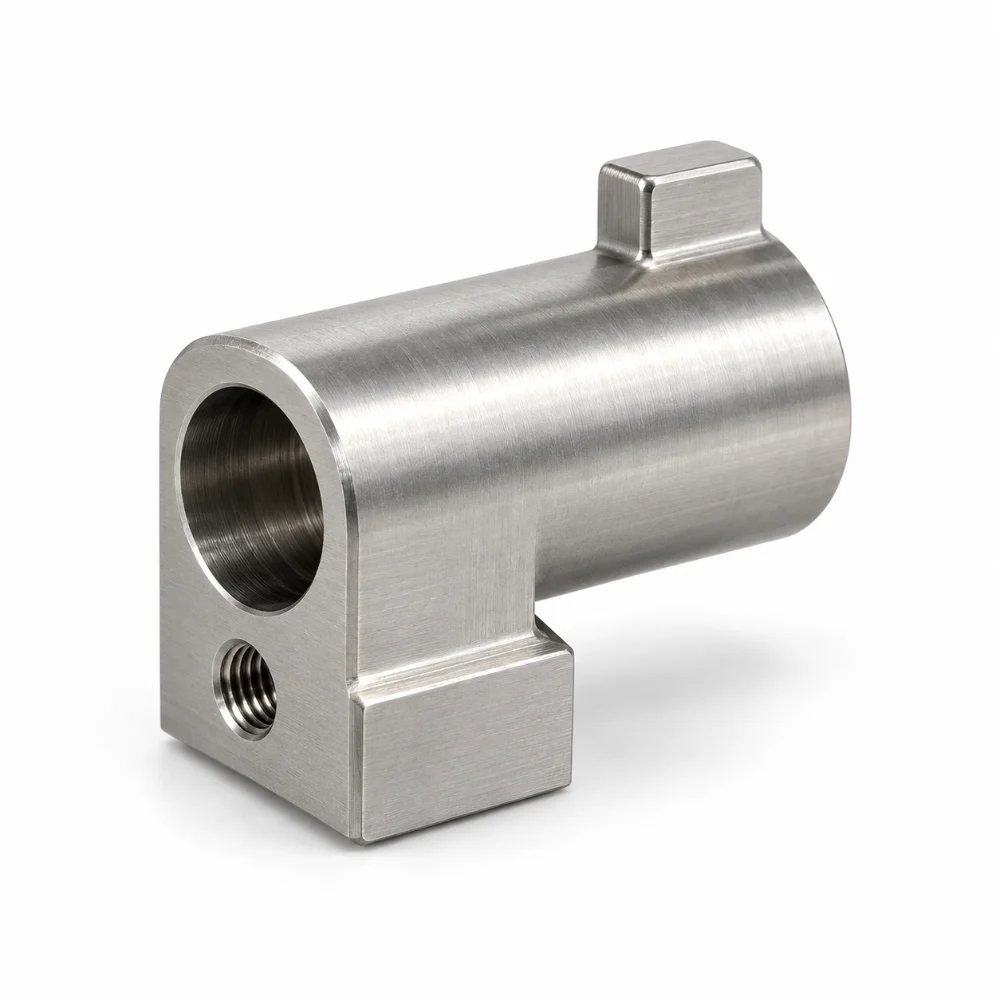
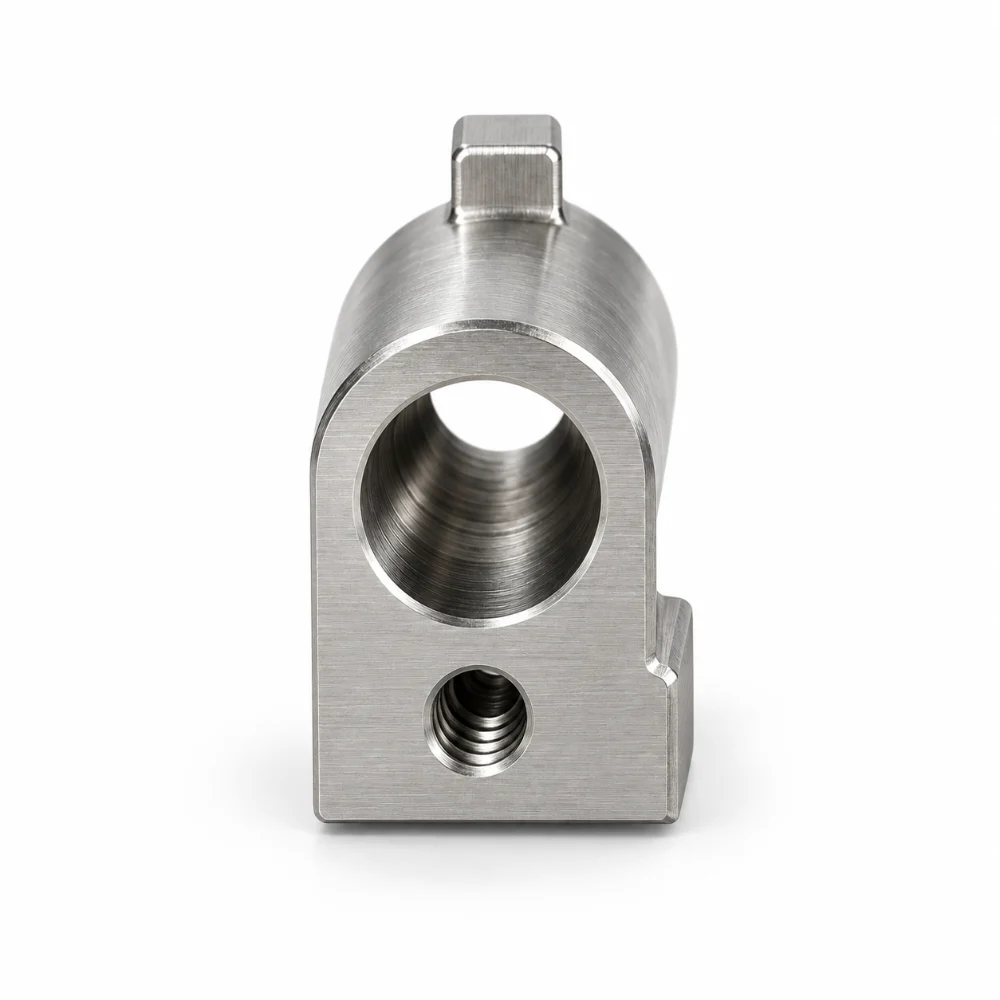
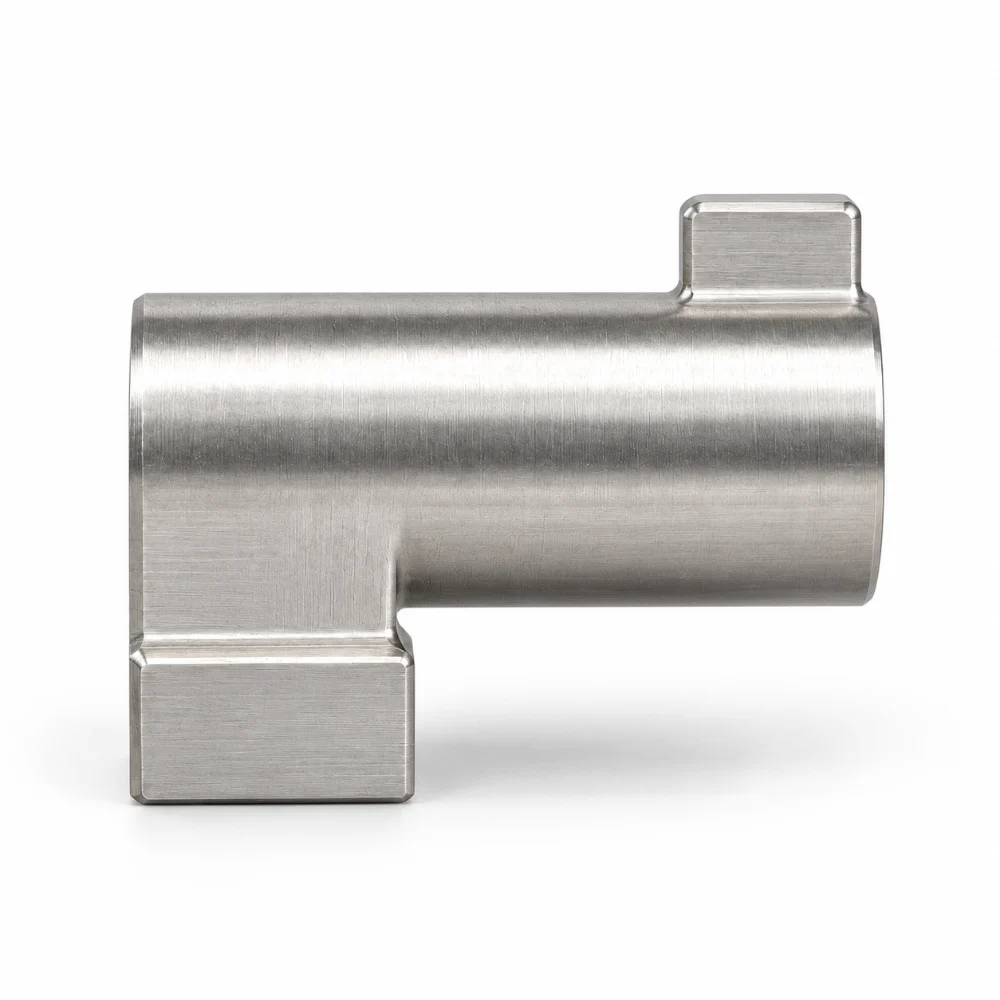


304 Stainless Steel CNC Machined Stator Lock Post
This 304 Stainless Steel CNC Machined Stator Lock Post is a custom precision component manufactured according to customer-supplied engineering drawings for a stator lock and rotor installation assembly.
Made from SUS304 stainless steel, the part combines a cylindrical body, an integrated mounting section, precision-machined holes, and an internal M3 thread. Its compact design requires careful control of feature alignment, hole positioning, and dimensional accuracy.
The project specifies CNC milling, a precision tolerance target of ±0.001″ (±0.025 mm) for designated features, and passivation to support corrosion resistance.
-
Product Name: Stator Lock / Rotor Installation Post
-
Material: SUS304 Stainless Steel
-
Manufacturing Process: Precision CNC Milling, Drilling and Threading
-
Precision Tolerance: ±0.001″ (±0.025 mm), customer-stated target for critical features
-
Surface Treatment: Passivation
-
Main Features: Cylindrical Body, Precision Bore, M3 Threaded Hole and Stepped Mounting Features
-
Design Reference: Customer-Supplied Engineering Drawings
-
Production Type: Custom CNC Machined Component
 Get Free Quote


Precision CNC Milling for Stainless Steel Components
This project demonstrates how precision CNC machining can produce compact stainless steel components with multiple functional features.
Unlike standard cylindrical parts, this component combines rounded and flat surfaces, a stepped body, mounting features, and closely positioned holes.
The manufacturing process requires controlled machining sequences to preserve the relationship between these features.
Key Manufacturing Challenges
1. Controlling the Cylindrical Profile
The cylindrical body must maintain its specified geometry while remaining properly aligned with the machined mounting surfaces. Suitable workholding and machining strategies help reduce dimensional variation.
2. Precision Hole Machining
The customer drawing includes a Ø3.4 mm through-hole, a Ø6.5 mm counterbore with a specified depth, and an additional threaded-hole feature. Accurate hole positioning is important for component assembly and alignment.
3. M3 Internal Thread Machining
The drawing specifies an M3 × 0.5–6H internal thread. Proper drilling, tapping, and thread inspection are important for reliable engagement with mating fasteners.
4. Machining Small Stepped Features
The part contains small external projections and transitions between cylindrical and rectangular surfaces. CNC milling helps produce these details according to the required geometry.
5. Maintaining Dimensional Accuracy
The customer specifies precision requirements down to ±0.001″ for designated features. Individual dimensions and geometric tolerances must also follow the approved engineering drawing.
6. Stainless Steel Passivation
After machining, passivation is used to remove surface free iron and support the corrosion-resistant passive layer of SUS304 stainless steel. This chemical treatment does not require adding a decorative coating.
Detailed Technical Specifications
| Parameter | Specification |
|---|---|
| Product Name | Precision CNC Machined Stator Lock Post |
| Customer Part Description | POST, STATOR LOCK, ROTOR INSTALL |
| Material | SUS304 / AISI 304 Stainless Steel |
| Manufacturing Process | CNC Milling, Drilling and Threading |
| Customer-Stated Precision | ±0.001″ (±0.025 mm) |
| Selected Diameter Requirement | Ø9.25 ±0.10 mm |
| Selected Linear Dimensions | 11.50 ±0.05 mm / 2.75 ±0.05 mm |
| Main Through-Hole | Ø3.4 mm |
| Counterbore | Ø6.5 mm × 16.0 mm Deep |
| Internal Thread | M3 × 0.5–6H |
| Typical Edge Radius | R0.5 mm |
| Surface Treatment | Passivation |
| Inspection Requirements | Drawing-Based Dimensional and Thread Verification |
| Manufacturing Type | Custom Precision CNC Machining |
Note: The ±0.001″ figure is the customer-stated machining precision target. Specific dimensional and geometric tolerance callouts on the drawing govern the relevant individual features.
Quality Control for Precision Machined Parts
Producing small stainless steel parts with multiple critical features requires consistent machining and inspection.
For this type of component, the quality control plan should focus on several areas.
- Dimensional Verification: Check critical diameters, lengths, and machined profiles against the engineering drawing.
- Hole Position Inspection: Verify the relative positions of drilled and threaded features using the specified datums.
- Thread Inspection: Use appropriate thread gauges to check the M3 internal thread.
- Surface Inspection: Inspect machined edges, bore openings, and stepped features for burrs or visible defects.
- Post-Passivation Inspection: Confirm the required appearance and any customer-specified acceptance criteria after surface treatment.
A drawing-based inspection process helps maintain consistent component geometry during repeat production.
Potential Applications
The customer drawing identifies this component as a stator lock and rotor installation post. Its exact end-use equipment has not been independently confirmed.
Similar custom precision-machined components may be used in:
Motor Assembly Equipment
Specialized mechanical parts for stator positioning, rotor installation, and component alignment, depending on the assembly design.
Industrial Automation
Custom posts, positioning components, and mounting elements used in automated mechanical systems.
Precision Assembly Fixtures
Machined parts requiring accurate locating features, controlled hole positions, and repeatable dimensional fit.
Custom Mechanical Equipment
Specialized stainless steel components manufactured to meet application-specific drawings and assembly requirements.
Benefits of SUS304 Stainless Steel CNC Machining
Good Corrosion Resistance: SUS304 is widely used in equipment and mechanical components requiring resistance to many common corrosive environments.
Precision Feature Manufacturing: CNC milling supports complex stepped geometries, mounting features, and accurate hole machining.
Consistent Assembly Fit: Drawing-based machining and inspection help control the dimensions that affect compatibility with mating components.
Passivated Surface: Passivation supports the corrosion resistance of the stainless steel without substantially changing the intended component geometry.
Drawing-Based Customization: Component dimensions, hole arrangements, thread specifications, and finishing requirements can be tailored to an approved design.
Frequently Asked Questions
1. What is a CNC machined stator lock post?
A stator lock post is a customer-defined mechanical component associated with a stator locking or rotor installation assembly. This particular part combines a cylindrical body, mounting features, precision holes, and an internal thread.
2. Why is SUS304 stainless steel used for this component?
SUS304 offers good corrosion resistance, useful mechanical properties, and suitability for precision machining. It is commonly selected for customized industrial and mechanical equipment components.
3. Can CNC milling achieve ±0.001″ tolerance on stainless steel parts?
Yes, ±0.001″ (approximately ±0.025 mm) can be achievable for selected features with suitable equipment, tooling, and inspection. Actual achievable tolerances depend on component geometry, feature size, material condition, and manufacturing requirements.
4. What is the purpose of passivation after CNC machining?
Passivation helps remove free iron contamination from stainless steel surfaces and supports the formation of a stable protective oxide layer. It is often specified for corrosion-resistant precision components.
5. Can custom stainless steel parts be manufactured from engineering drawings?
Yes. Custom components can be evaluated for manufacturing using customer-supplied 2D drawings or 3D CAD models. Material specifications, tolerances, surface treatment requirements, and order quantities should be reviewed before production.
| Parameter Item | Technical Specification |
|---|---|
| Product Name | Stainless Steel Brushed Bathroom Hook / Wall-Mounted Storage Parts |
| Main Material | 304 Stainless Steel (316 Stainless Steel / Zinc Alloy optional) |
| Manufacturing Process | CNC Turning + Stainless Steel Straight/Snowflake Grain Brushing Composite Process |
| Surface Roughness | Ra 1.6 (As-machined) / Ra 0.8 (After brushing) |
| Dimensional Tolerance | ±0.1mm |
| Static Load-Bearing Capacity | ≥5kg |
| Salt Spray Test | ≥72 hours (Neutral salt spray) |
| Brushing Texture | Straight grain / Snowflake grain (Customizable on request) |
| Production Capabilities | Prototyping, Low-volume Customization, Mass-volume Production |
| Working Conditions | Humid and watery environment use, wall-mounted storage load-bearing, bathroom/kitchen/hotel scenarios |